
Selling Online in the Philippines: Registration, the 1% Platform Withholding, and E-Invoicing
By Tamoogi Team
What an online seller on Shopee, Lazada, TikTok Shop, or Facebook needs from DTI, the BIR, and the LGU, how the 1% withholding on platform remittances works, and who must issue e-invoices by the end of 2026.
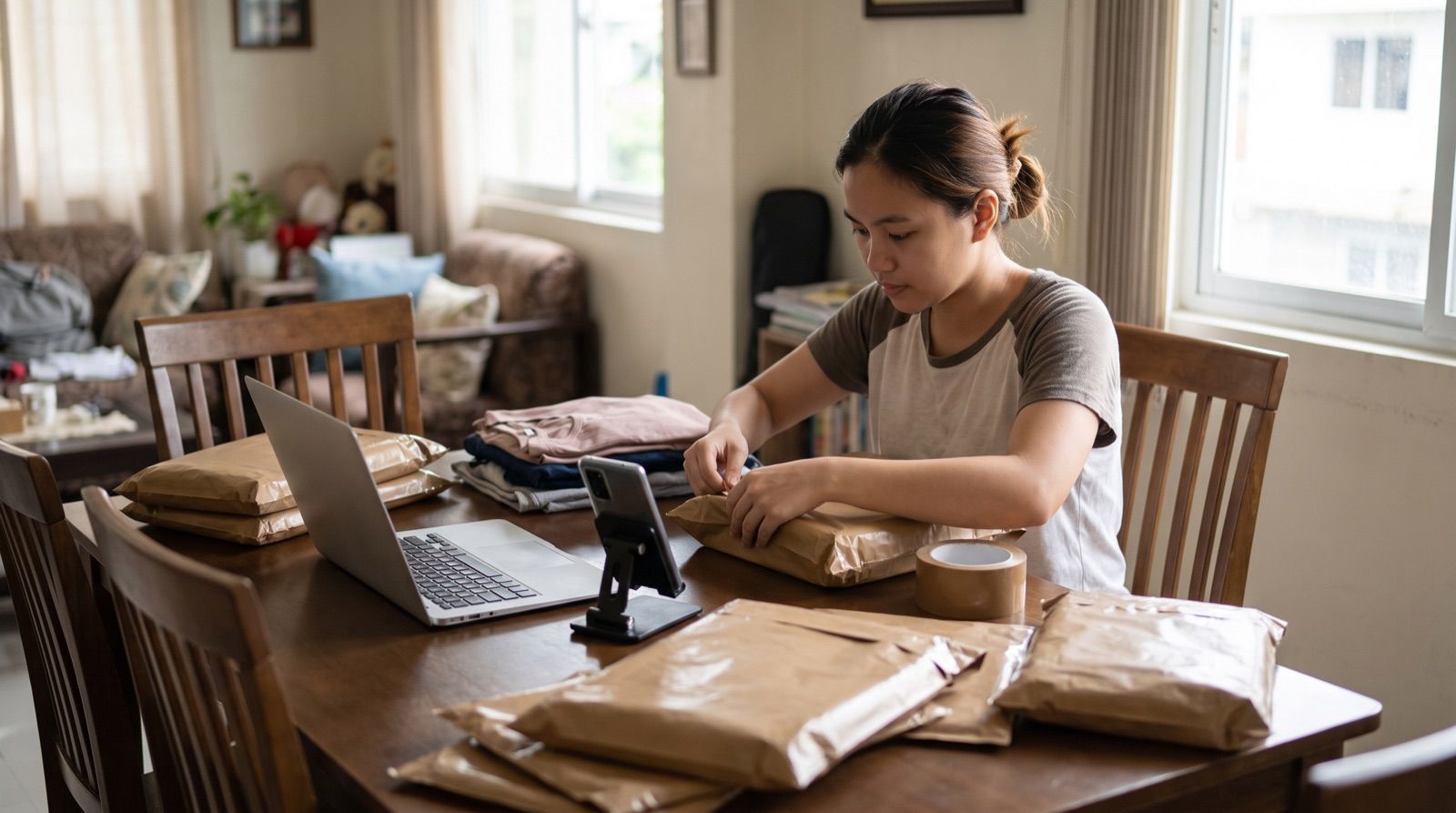
The marketplaces made it official for you: Shopee, Lazada, TikTok Shop, and the payment apps now ask for a BIR Certificate of Registration before they onboard a seller or release withheld tax certificates. Selling online has been a registrable business since the BIR’s first circular on the subject in 2013. What changed in the last three years is that the platforms enforce it, withhold tax on your payouts, and, from the end of 2026, some sellers must issue electronic invoices.
This guide walks through the registrations in order, the withholding rule, and what to file each quarter.
Registrations, in order
| Step | Agency | Who needs it |
|---|---|---|
| 1. Business name | DTI (sole proprietor using a trade name) or SEC (corporation, partnership, OPC) | Anyone trading under a name other than their own |
| 2. Barangay clearance | Your barangay | Most sellers, as a prerequisite for the permit |
| 3. Business permit | City or municipal hall | Depends on the LGU; most require a home-based business permit for selling goods from a residence |
| 4. BIR registration | Your RDO, through ORUS | Everyone |
| 5. Invoices and books | BIR | Everyone, after registration |
Steps 1 to 3 are covered in our sole proprietorship registration guide and the barangay clearance guide. If you are deciding between a sole proprietorship and a one person corporation, this comparison covers the trade-offs.
BIR registration for a seller
- Register through ORUS with Form 1901 (individuals) or 1903 (corporations). A seller with no shop registers with the RDO covering the home address.
- Choose your tax types. Income tax, plus either percentage tax (non-VAT, gross sales of ₱3 million or less) or VAT. Individuals under ₱3 million can elect the 8% income tax option, which replaces both the graduated income tax and the percentage tax and suits most small sellers.
- Get your Certificate of Registration. Upload it to each platform’s seller centre; without it, platforms treat you as unregistered and withhold on every remittance.
- Apply for invoices. Printed invoices through an accredited printer with an Authority to Print, or a registered POS or invoicing system. Since the EOPT Act, the invoice is the primary document for every sale; see our invoice guide.
- Register your books of accounts through ORUS. A simple set of manual books is enough for most sellers.
There is no annual registration fee anymore; it was removed in 2024.
The 1% withholding on platform payouts
RR No. 16-2023 requires e-marketplace operators and digital financial services providers to withhold a creditable income tax on the money they remit to sellers:
| Rule | Detail |
|---|---|
| Rate | 1% of one-half of the gross remittance, an effective 0.5% |
| Threshold | Applies once your cumulative gross remittances through the platform in the taxable year exceed ₱500,000 |
| Exceptions | Sellers who are income-tax-exempt or subject to a lower rate, with a sworn declaration and proof filed with the platform |
| Your proof | The platform issues Form 2307 for the amounts withheld |
| Effect on your taxes | The withheld amount is an advance on your income tax. Claim it as a credit on your 1701Q and annual return |
Two points sellers miss. First, the ₱500,000 test is per platform and based on remittances, not profit, so a reseller with thin margins reaches it quickly. Second, the credit is only useful if you file; a seller who never files returns loses the withheld tax entirely.
What to file each quarter
| Return | When | Who |
|---|---|---|
| 1701Q | May 15, August 15, November 15 | Individual sellers |
| 2551Q | 25th of the month after each quarter | Non-VAT sellers not on the 8% option |
| 2550Q | 25th of the month after each quarter | VAT-registered sellers |
| 1701 or 1701A | April 15 | Individual sellers, annual |
Attach the 2307s from the platforms to claim the credit. The 1701Q guide walks through the computation.
Invoices for every order
Each sale of ₱500 or more needs an invoice, and a buyer can ask for one at any amount. For marketplace orders, sellers typically issue the invoice with the parcel or keep a daily summary invoice for small orders, depending on what the RDO accepts for the registered invoice format. Platform order confirmations are not BIR invoices.
Crossing ₱3 million in gross sales brings two changes at once: VAT registration (see the VAT threshold guide) and the e-invoicing mandate. RR No. 11-2025 puts businesses engaged in e-commerce or internet transactions in the first group required to issue electronic invoices and report sales electronically, with a compliance deadline of December 31, 2026 under RR No. 26-2025. Micro taxpayers are excluded for now.
The Internet Transactions Act
The Internet Transactions Act of 2023 (RA 11967) created the DTI’s E-Commerce Bureau and requires platforms to verify their sellers and sellers to display their business name and registration details on their online store. Platforms have been rolling out the verification steps, which is one more reason the Certificate of Registration is now requested at onboarding. Keep your DTI or SEC and BIR details visible on your shop page.
A seller’s checklist
- DTI business name if you use a trade name, or SEC registration for a corporation
- Barangay clearance and a business permit, if your LGU requires one for home-based sellers
- BIR Certificate of Registration, uploaded to each platform
- Registered invoices and books
- A folder for the 2307s each platform issues
- Quarterly 1701Q and 2551Q (or 2550Q), and the annual return
- A plan for e-invoicing before December 31, 2026 if sales are at or above ₱3 million
Questions and answers
Common questions
- Do I need to register with the BIR if I only sell on Facebook or Shopee?
- Yes. Anyone engaged in business, online or not, registers under Section 236 of the Tax Code. The BIR has said so repeatedly since RMC No. 55-2013 and RMC No. 97-2021, and marketplaces now ask for your Certificate of Registration before they let you sell or release payouts.
- What is the 1% withholding on online sellers?
- Under RR No. 16-2023, e-marketplace operators and digital payment providers withhold a 1% creditable tax on one-half of their gross remittances to sellers, an effective 0.5%. It applies once your annual gross remittances through the platform exceed ₱500,000. The amount withheld is an advance on your income tax, credited on your return using the Form 2307 the platform issues.
- Do I need a DTI business name?
- Only if you trade under a name other than your own full name. A sole proprietor selling as Juan dela Cruz needs no DTI registration; one selling as Juan's Gadget Hub does. Corporations and partnerships register with the SEC instead.
- Do home-based online sellers need a mayor's permit?
- It depends on the LGU. Many cities require a home-based business permit for anyone selling goods from a residence, with lower fees than a storefront. Check your city or municipality's business permits office; the barangay clearance usually comes first.
- Will I have to issue electronic invoices?
- If your gross sales are ₱3 million or more and you sell through e-commerce or internet transactions, yes, by December 31, 2026 under RR No. 11-2025 and RR No. 26-2025. Micro taxpayers below ₱3 million are excluded for now, but still issue regular BIR-registered invoices for every sale of ₱500 or more.
Keep the next filing easier to find
Tamoogi keeps the task, due date, and supporting documents together for every business you manage.
Start a 30-day free trial